







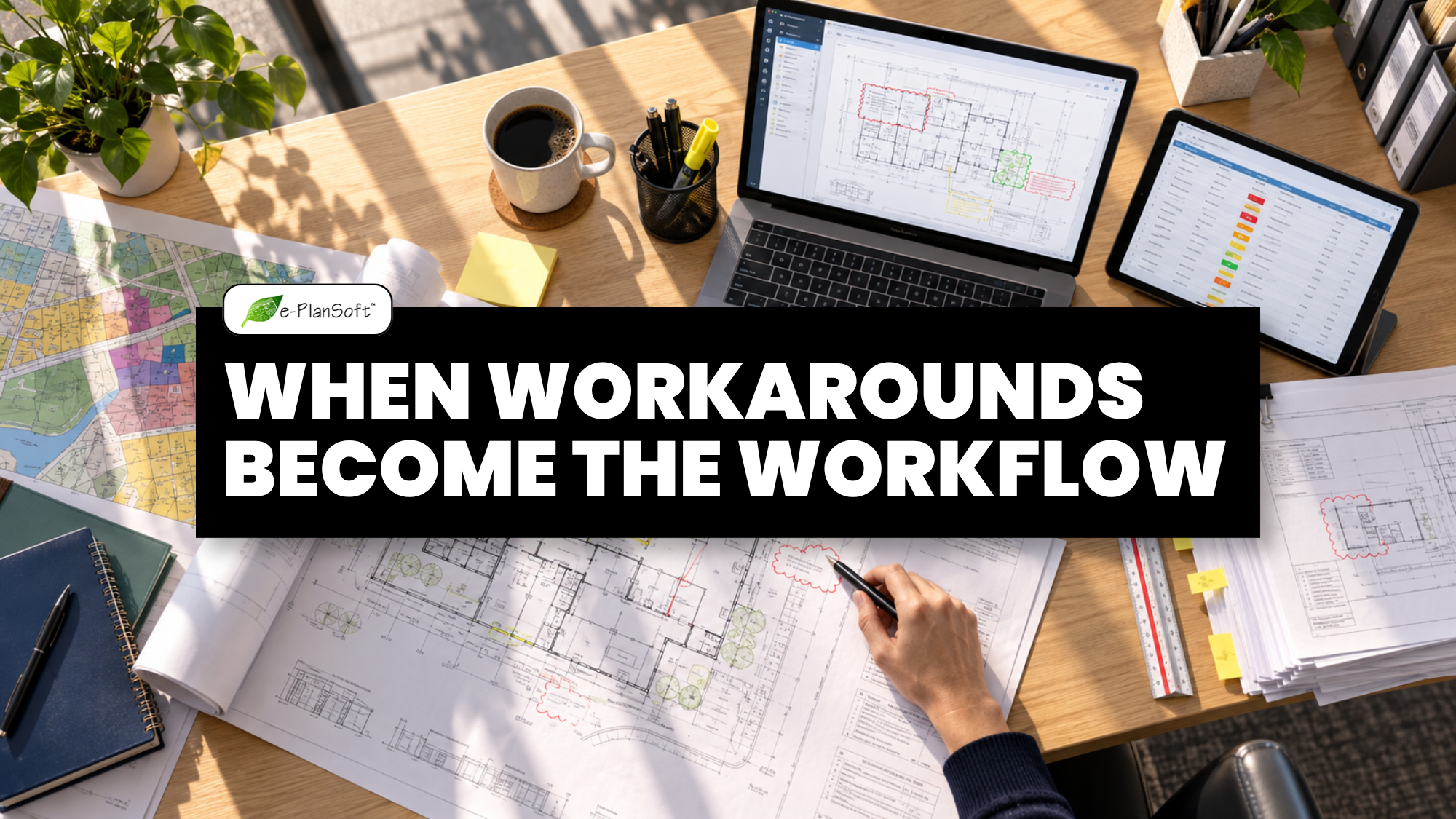
You can make almost any plan review process work.
Paper can work. Generic PDF markup tools can work. The plan review module that came with your permitting system can work, too.
Until they don’t.
Most plan review teams don’t wake up one morning and decide their process is obsolete. More often than not, they adapt around its limitations.
They add a spreadsheet. Someone starts tracking reviews manually. Reviewers save standard comments in Word. Staff email applicants for clarification. Someone else keeps an eye on which departments are running behind.
Each workaround is manageable on its own. Eventually, though, the workarounds become the process. And when that happens, you’ve reached the breaking point.
Have You Reached Your Breaking Point?
Old doesn’t mean broken.
For decades, plan reviewers got by just fine with pen and paper. When local governments moved from filing cabinets to computers, PDFs became the primary medium.
It’s not that you need plan review software because every solution until now is “bad.” The question is whether your current process is getting in your way and holding you back more than it helps.
In our experience, these problems manifest in three places:
- Applicants. Are people waiting longer, struggling to understand where their review stands, getting inconsistent feedback, or going through review cycles that could have been avoided?
- Staff. Are reviewers and permit staff spending too much time chasing people, moving files, tracking down information, combining comments, or figuring out which version they're supposed to review?
- Everything else. Is plan review getting in the way of other improvements you're trying to make? Maybe you've modernized permitting, set turnaround-time goals, or want better reporting and automation, but plan review still depends on manual work.
One headache probably isn't a reason to replace your system. But two or three? That’s when you should step back from “what works now” and start asking, “what could work better?”
The 8 Signs Your Plan Review Process is Broken
Having worked with lots of local government teams of varying sizes, we've seen the following top eight signs that your plan review process may be reaching its breaking point.
If any of them ring true, it could be a sign it’s time to rethink your plan review process.
1. You're Still Printing Plans
This is the easiest one to recognize.
Plans arrive electronically but get printed for review. Physical sets move between disciplines. Reviewers make handwritten markups. Someone scans documents back into the system when the review is complete.
That may work perfectly well at low volume. But as submissions increase, plan sets get larger, or more disciplines get involved, someone has to keep track of where the plans are, who has reviewed them, and where they go next.
Just because you went digital with PDFs doesn’t mean this problem is completely solved.
If PDFs live in folders and staff manually move, rename, email, download, and upload them as a review progresses, you may have eliminated the paper without changing much about the process. Email also creates many of the same routing and visibility problems.
2. Generic PDF Software Has Become Your Plan Review System
PDF markup software is very good at marking up PDFs. If you work primarily in PDF, then that’s great. But what about the other aspects of plan review beyond PDF markup?
Things like reviewing status updates, collaborating on the same PDF across disciplines, or managing comments? How about turning comments into corrections, or comparing a new submission to the old one?
PDF was built to review and annotate documents at a small scale, not for the robust needs of modern plan review. If the software can only handle the document while your staff handles the rest of the workflow, you may have outgrown the tool.
3. Your Permitting System Technically Does Plan Review, but Reviewers Work Around It
Many permitting and community development platforms include some form of electronic plan review.
For some jurisdictions, that's enough. The warning sign is when reviewers routinely leave the system to do their work. Maybe your permitting system doesn’t have a great markup tool, so you download PDFs to review manually. Then you keep comments somewhere else, and staff maintain spreadsheets because the information they need isn’t easy to find in the system.
Suddenly you have to create a separate process on top of your existing software. For small plan sets, this may not be a problem. But larger files or complicated submissions break this quickly.
You may have an electronic plan review, but your staff is still holding the process together.
4. Someone has Become the Human Traffic Controller
Who keeps reviews moving? Is it a dedicated person, or the process that you follow?
If you rely on someone to figure out which disciplines need to review a submission, where files go next, and whether reviews are complete, you have a problem. For one, it’s tedious for them, but more importantly, if they were to go on vacation or leave, it stops your plan review process in its tracks until they return or are backfilled.
We've written before about what happens when someone has to babysit the plan review process.
Some coordination will always be necessary. But with the right tools, plan review can be a self-sustained workflow and not an exercise in reminding everyone to follow up on their plan sets. That’s how you avoid paying skilled people to chase the work instead of doing the work.
5. Resubmittals Make Reviewers Hunt for What Changed
The first review isn’t always the problem. It’s the resubmissions that can be a time sink.
When an applicant submits a revised plan set, how easy is it for you to figure out which sheets changed, what changed on those sheets, whether previous comments were addressed, and which parts of the plan actually need another look?
Without a good way to compare versions, reviewers have to hunt for what changed before they can review it.
That's time they could be spending on the parts of the plan that actually need their attention. And sometimes what looks like a resubmittal problem is really a communication problem between the reviewer and applicant.
6. Comments Have Become Their Own Workflow
If your commenting process includes any of the following: 10+ page Word documents, Excel files, saved PDFs, copy-and-paste, personal libraries, email templates, or "I just know what I usually write," there's probably work to do.
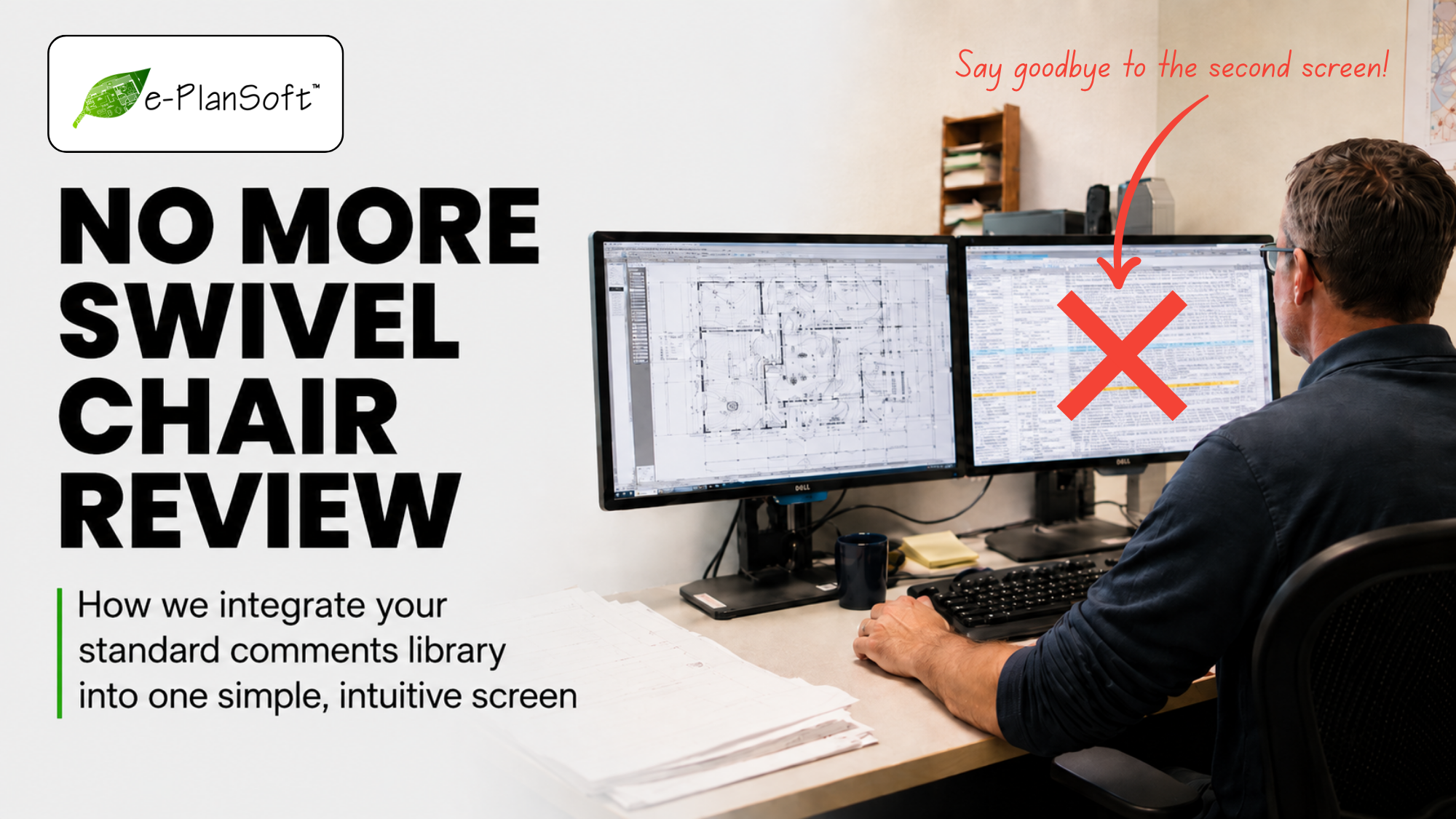
Standard comments should save reviewers time and help applicants get consistent feedback. But that only works if the library itself is easy to use and maintain. We recently broke down how standard comments should work inside an electronic plan review workflow.
The same problem shows up at the end of a review. Someone collects comments from several departments, cleans them up, removes duplicates, and assembles the final response.
If staff have to assemble the comments by hand, you haven't really automated the review. We call this the double-entry problem: reviewers finish the actual review, then effectively do part of the work again to produce the correction letter.
7. You Can't Quickly Answer, "Where is This Review?"
Maybe an applicant is being insistent on getting an update. Or perhaps your city has to operate on tight deadlines. Whatever it is, at some point during the review process, someone will ask what stage a plan is in and how long the review will take.
How hard is it to answer?
If someone has to check several systems, send an email, open a spreadsheet, or ask around, that's a problem. That problem compounds when you need to stick to an SLA.
If you've promised a certain turnaround time, you need to know when a review arrived, when it reached a reviewer, how long it sat there, when it was completed, and where delays occurred. And you should be able to report on it.
If someone has to build a spreadsheet every time you want to know whether you're hitting your turnaround targets, the system isn't giving you what you need.
8. Plan Review is the Holdout in an Otherwise Modern Process
Sometimes the trigger isn't a crisis inside plan review. It could be that everything else is changing.
For example, let’s say your jurisdiction moves permitting online. Now, payments are electronic, inspections are monetized, and you replace your permitting platform. Great. The problem is that leadership will ask for better reporting and AI adoption across disciplines, but plan review still depends on downloads, uploads, email, shared drives, spreadsheets, or physical documents.
That makes integrations harder, reporting worse, and new automation harder to add.
You shouldn't have to rebuild information that already exists in your permitting system just to review a plan. And staff shouldn't have to move information manually between systems just to keep the process going.
Going Electronic Isn't the Point
Going digital isn’t the point.
Managing plan review over PDFs and email is already electronic, in a sense. It’s a question of efficiency.
You can receive and mark up a PDF, but can you send a large file easily over email or reconcile comments across five disciplines for one plan set?
Without a dedicated plan review solution, the answer is often “no,” and while these inefficiencies may seem tolerable in isolation, they compound over time and add hours to each plan review cycle.
If you find that, despite all your modernization efforts, people are still chasing down reviewers, copying comments across systems, or reconciling plan set versions by hand, it’s time to look for a new solution: one that removes the extra work in the plan review process.
That’s where dedicated plan review software can help. Plan review software like e-PlanSoft can help you manage the core aspects of plan review digitally:
- Intake: Accept submissions from applicants and run AI-powered checks to flag errors upfront.
- Review: A PDF-like markup experience that lets you and every other discipline work from the same document, not a copy that gets reconciled later.
- Feedback: Comments can be automatically compiled into a corrections list for the applicant. When applicants resubmit, you can automatically flag what changed from the last version.
The only question now is, what plan review software will you choose?
Your permitting suite may offer a lightweight plan review option. Large city governments may want an enterprise solution. Or maybe you fall somewhere in the middle.
Check out our guide to the best plan review software for every use case. We compare the most popular vendors to help you choose the best fit for your needs.
Want to see how digitizing your plan review can improve intake, review, and applicant feedback? Get in touch today to see e-PlanSoft for yourself.
 e-PlanSoft™ Team