A few weeks ago I was walking by a friend’s house in Chicago. This friend happens to be in the middle of a remodeling project. And I did the thing I always do at a construction site: I stopped and read the building permit taped up in the window.
(When you work for a plan review software company, this is kind of a thing that you do.)
The permit had all the details you’d expect: permit number, address, description of work, owner, contractor, and signature’s at the bottom.
But further down, near bottom of the permit, in a little box, was something I’d never seen printed on a permit before:
Total Permit Processing Time: 48 days
Time for City Review: 29 days
Time With Applicant for Document Submittal and Corrections: 19 days
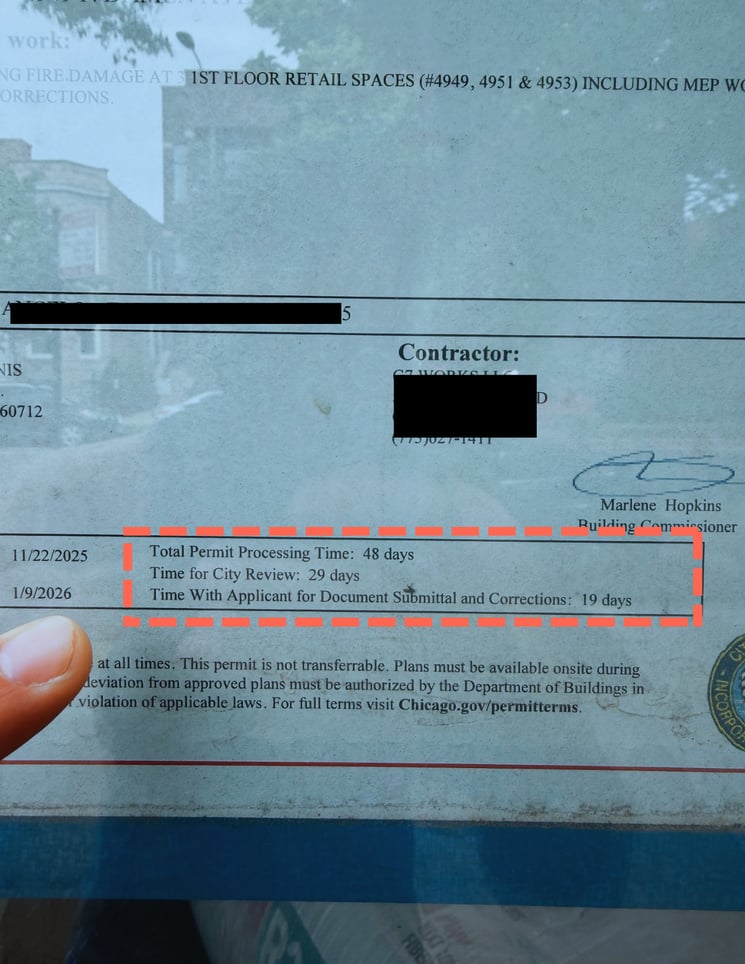
Take a closer look here: Chicago isn’t just reporting how long the permit took. It’s reporting on both how long it took for the city to do its part of getting the permit approved, and how long it took the applicant to do their part.
This permit was applied for on November 22 and issued on January 9 — 48 days total, including the holidays.
But of those 48 days, the permit was only in the city’s hands for 29.
The other 19 (40% of the total timeline) were spent waiting on the applicant to submit their corrected documents.
Chicago isn't just reporting on that split for internal purposes. They want the public to know how long their part took and how long the applicant's part took.
Interesting.
Why Split Reporting Matters
When a permit takes a long time to get approved, the permit issuer (i.e., the city) typically takes the blame. That’s the headline number that shows up in city council meetings, contractor forums, and local news stories: Total elapsed time, application to issuance.
But anyone who has worked inside a permitting office knows that cycle (and the time that it takes) is not a one-player game.
There’s a review clock, which runs while plans sit with the city, and a response clock, which runs while comments sit with the applicant. Every resubmitted plan set bounces the ball back and forth. And when a city publishes or reports only the total cycle time, it takes ownership of all criticism for a timeline it only partially controls.
Printing the split (right on the permit, where everyone can see it) does three things at once.
-
It gives the city a defensible account of its own performance.
-
It quietly reminds applicants that their responsiveness is part of the timeline, and that it’s now on the record.
-
It creates a baseline: you can’t speed up a cycle you’ve never measured in the first place.
How Other Cities Are Evolving Their Permit Reporting
Once you start looking, you find a small but growing club of cities separating “our time” from “your time” — and getting creative about how they create transparency around the multiple inputs and points of accountability around the plan review process.
-
Seattle reports “calendar days in City control” as its core permitting metric, explicitly excluding time when the application is with the applicant. Its published goals (for example, 30 days in city control for commercial alterations) are tracked by a dedicated Permitting Accountability and Customer Trust (PACT) team. Most striking stat on the page: total calendar days experienced by the applicant are roughly twice the days in city control. In other words, about half of “permit delay” isn’t the city.
-
San Francisco publishes permit performance dashboards under its PermitSF reform effort that separate the time the city spends reviewing plans from the time applicants spend correcting and resubmitting them. The city set review-time targets for every step — completeness check, first review, revision review — and aims to hit them at least 75% of the time.
-
Portland launched enhanced dashboards that show average timelines by review phase — and specifically call out the average time customers take to respond to requests for more information or updated plans. The city frames it as accountability in both directions.
-
Florida and Texas have gone further and put teeth on the city’s side of the clock. Florida’s permit “shot clock” law requires local governments to act on complete applications within statutory deadlines — with fee refunds of 10–20% per business day when they miss, and automatic approval if the clock runs out entirely. Texas passed a similar shot-clock law for development applications back in 2019. Notice the design, though: the clock only runs on complete applications. The state holds cities accountable for city time — not applicant time.
Where this is heading
Two ideas are converging here.
The first is that governments should be publicly accountable for the part of the timeline they control.
The second is less visible but just as important: a meaningful share of what gets called “permit delay” actually occurs when the applicant has the permit application back in their hands — follow-ups from incomplete submittals, slow corrections, and working on the next rev of the plan set. Seattle’s data says it’s about half of the total time to get a permit approved. On the Chicago permit in my friend’s window, it was 40%.
At e-PlanSoft, we expect more cities to adopt tactics like this. It costs almost nothing to publish, it defends hardworking review staff against criticism they don’t fully deserve, and it applies gentle, public pressure on the other half of the equation. It’s hard to think of another permitting reform with that much leverage per dollar.
You can’t report what you don’t measure
Here’s the catch: that little box on the Chicago permit is only possible if your systems know when the ball changed hands. Paper plan sets and email attachments can’t tell you that. Electronic plan review can, automatically: every submittal, every comment letter, every resubmittal is a timestamped handoff.
And once you can see the split, you can improve both halves of it. On the city side: parallel reviews across departments, workload visibility, fewer redundant touches. On the applicant side, the highest-leverage fix is one we write about often: clearer, better-organized comments. Applicants respond faster when they understand exactly what to fix the first time. (If your resubmittal cycles are long, it may be a communication problem more than a compliance problem.)
Our prediction: within a few years, publishing a single “total days” number will look as incomplete as a scoreboard that only shows one team’s points.
If your city published the city-time/applicant-time split today, what would it say — and would you be ready for the conversation that follows?
If you’d like to see how e-PlanSoft can help you track the handoffs in your plan review process (and how teams use that visibility to shorten their cycles) reach out at info@eplansoft.com.

 Debra Senra
 e-PlanSoft™ Team

 e-PlanSoft™ Team