








Key Takeaways
-
The true cost of plan resubmittals is the cognitive load required of reviewers to re-establish context and re-construct project history.
-
Without a plan review system that automatically points out differences between versions, reviewers must perform re-checks on unchanged sheets to ensure compliance, leading to delays.
-
Transitioning to a plan review system that prioritizes cognitive clarity allows agencies to shift their focus from manual data verification to impactful professional judgment.
Why Reprocessing Construction Plans Consumes So Much Mental Energy
Plan review is an unavoidably iterative process. Most construction documents go through multiple rounds of submission, comments, updates, and resubmissions. And it’s in that last step, the resubmission phase, where the most costly project delays begin.
That’s because each resubmittal adds an extra step to a reviewer's workflow—one they need to complete before the next round of review can begin.
And before a reviewer can evaluate new changes, they have to re-establish context. They need to remember what was previously reviewed, which comments were addressed, which ones still apply, and which sheets can be trusted, if any, without a full re-check. This work isn’t optional but a prerequisite for doing the job responsibly when you’re accountable for what gets approved.
This invisible step—reconstructing ground that was already covered—is where most of the effort in resubmittals actually lives.
The Real Work of a Resubmittal Isn’t Just Reviewing Changes
When a resubmittal lands in a reviewer’s queue, they have to rebuild a mental model of the last review cycle. In most environments, the electronic plan review system doesn’t help with this. That means the reviewer must manually:
- Flip between the previous plan set and the new version
- Check comment letters against individual sheets
- Verify which comments were resolved and which were ignored
- Confirm that unchanged sections really are unchanged
If your electronic plan review system can’t reliably highlight what stayed the same, the only safe option is to recheck everything. And that means scanning entire sheets, recounting elements, and re-validating relationships that were already cleared once before.
Not because reviewers want to double-check all these elements of the plan, but because that’s the only way to be certain and ensure compliance.


Why Manual Plan Comparison Is Uniquely Fatiguing
The exhaustion reviewers feel isn’t necessarily from the difficulty of the work but from constant context-switching. Over the course of a resubmittal, reviewers bounce between:
- Old versions and new versions
- Comment summaries and plan sheets
- PDFs and permitting systems
- Individual changes and overall project status
Research from the American Psychological Association shows that this kind of task switching reduces efficiency and increases mental fatigue—even in highly trained professionals like plan reviewers. The reason is simple: the brain doesn’t reset instantly. It has to reconstruct context before judgment can resume.
For plan reviewers, each resubmittal forces them to stop forward progress and re-orient themselves—again—before they can apply judgment with confidence. Even when the tasks themselves are familiar, switching increases mental effort, slows decision-making, and degrades accuracy over time.
How Modern Plan Review Software Reduces Cognitive Load
Cognitive overload is one of the biggest drains on plan review teams, especially during the second or third cycles. When a digital plan review system can’t effectively handle resubmittals and partial submittals, reviewers are forced to reconstruct history instead of doing actual review work.
Modern plan review software, however, changes that dynamic.
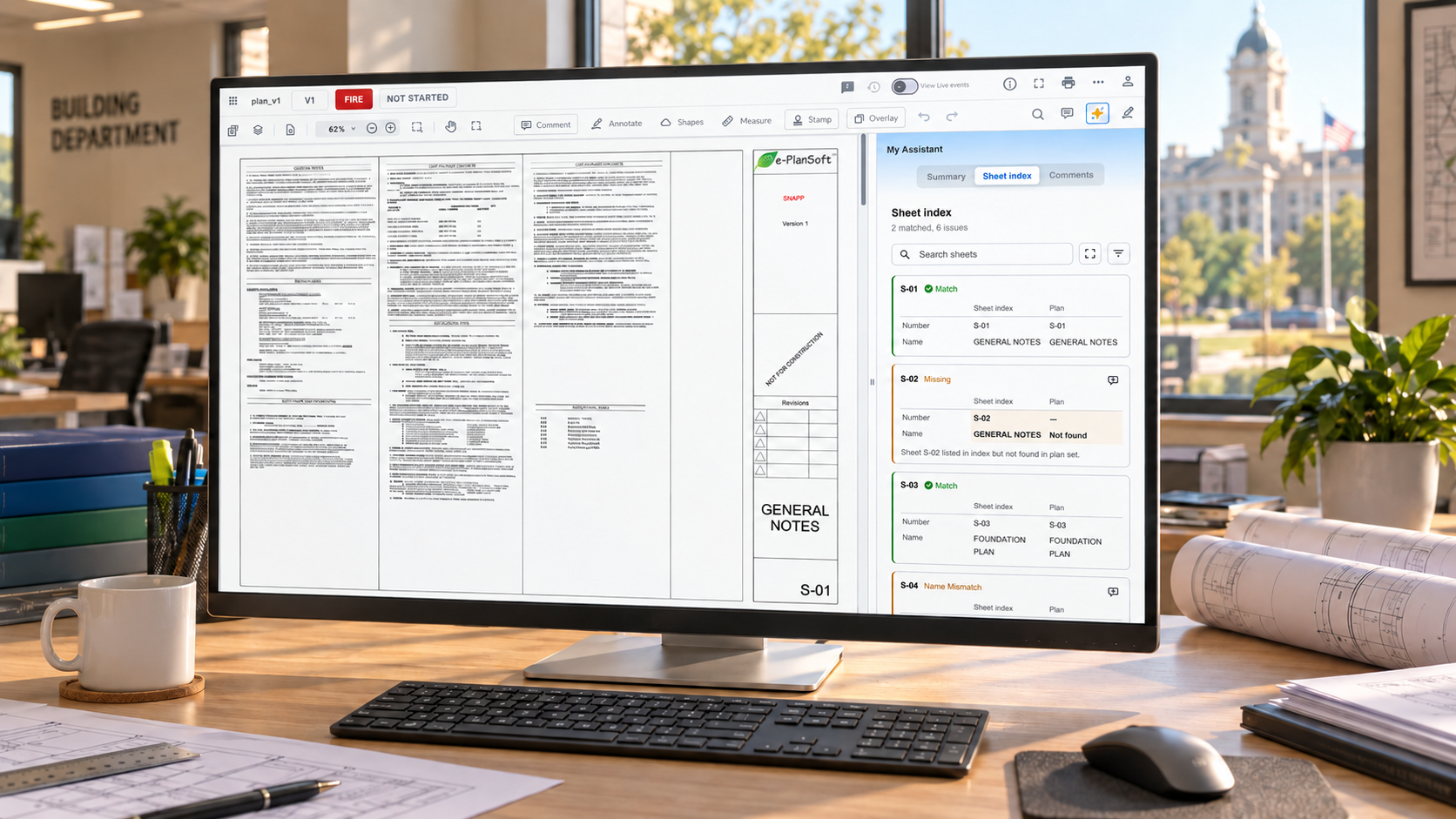
For example, when a system is built to natively support partial submittals, reviewers no longer waste time guessing what changed or re-reviewing what didn’t. Instead, the system does the heavy lifting:
- Precisely identifies changed, added, and unchanged sheets so attention is focused only where it’s needed
- Preserves comment context across cycles, keeping prior feedback tied directly to the relevant plan locations
- Maintains a clear audit trail of revisions, eliminating the mental tax of back-checking by memory
The impact is immediate: reviewers stop acting as historians and start operating as professionals applying judgment, code expertise, and experience. By reducing cognitive load, modern plan review software doesn’t just speed up resubmittals. Instead, it fundamentally improves decision quality, reviewer confidence, and the sustainability of the review workload itself.
Our Approach at e-PlanSoft
At e-PlanSoft, when we think about improving our products, we don’t start with features. We start with a simple question:
Does this alleviate the reviewer’s cognitive load?
If a capability helps reviewers quickly understand what changed, what didn’t, and what still requires judgment, it matters. If it simply adds automation without improving clarity, it doesn’t.
That philosophy shapes how we think about resubmittals—and more broadly, how we think about plan review systems. The goal isn’t speed for its own sake. It’s fewer unnecessary cycles, fewer defensive re-checks, and a workflow that supports good judgment instead of testing it.
So if you’re evaluating plan review tools—or hearing a lot of claims about automation and AI—we’re always happy to share where we think the real impact lives. We can walk you through how we’re solving the resubmittal bottleneck and supporting reviewers with tools built for their actual workday.
If this perspective resonates, we’d welcome the chance to compare notes and walk through how we’re tackling these problems in practice. Let’s schedule a conversation today.

 e-PlanSoft™ Team

 Matthew Abbitt