







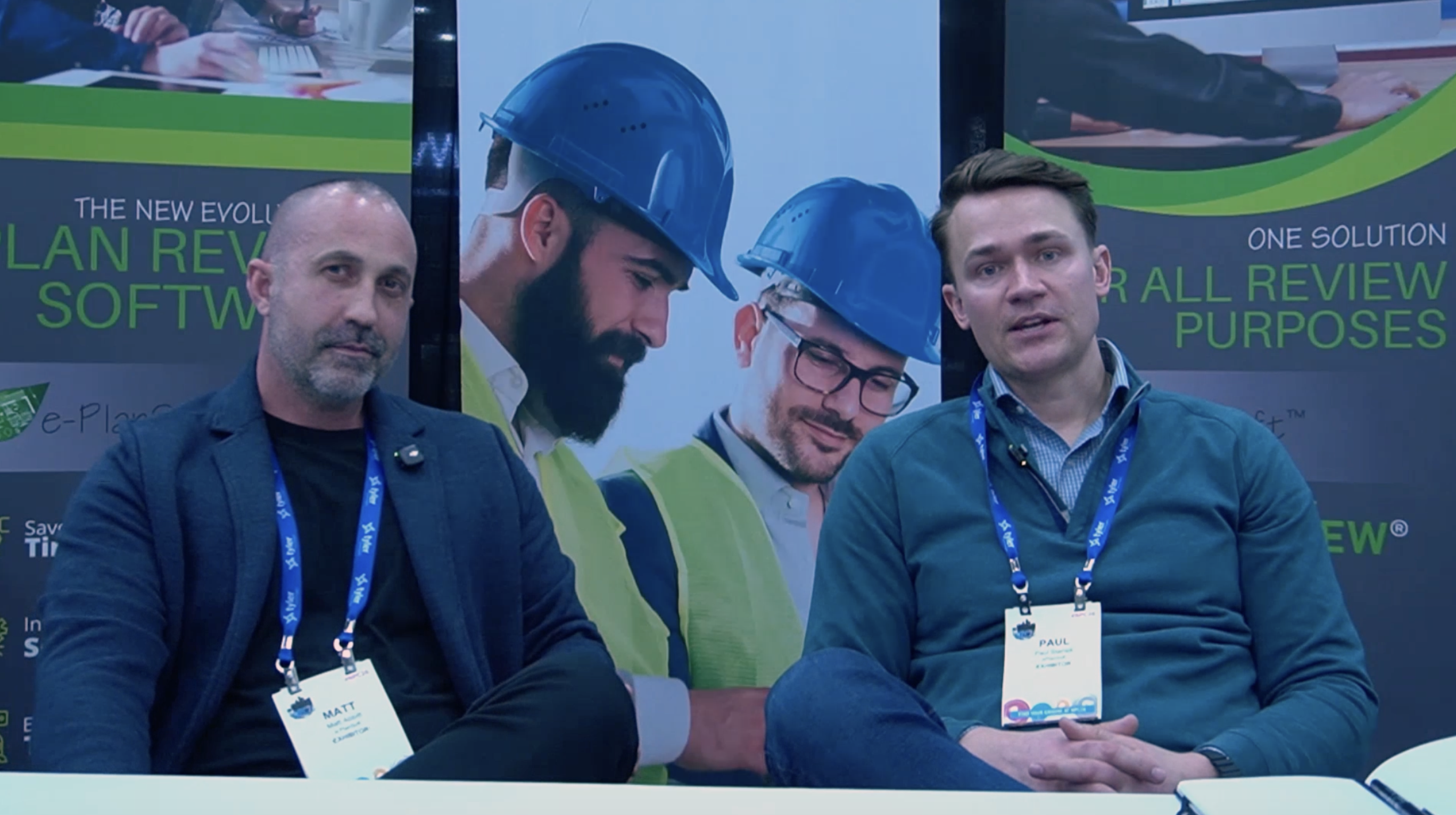
We just got back from the 2026 National Planning Conference in Detroit, where we spent most of the week walking the floor, listening to different conversations.
Across those conversations, there were two things that kept coming up:
1. Where does AI actually belong in real-world workflow?
2. And how do we help planning departments that are still struggling to move off paper and email?
In this blog, we’re breaking down our reflections from the conference, from the four places AI actually makes an impact to the signs it’s time to move off paper, and finally, our strategy for building tools that actually help plan reviewers.
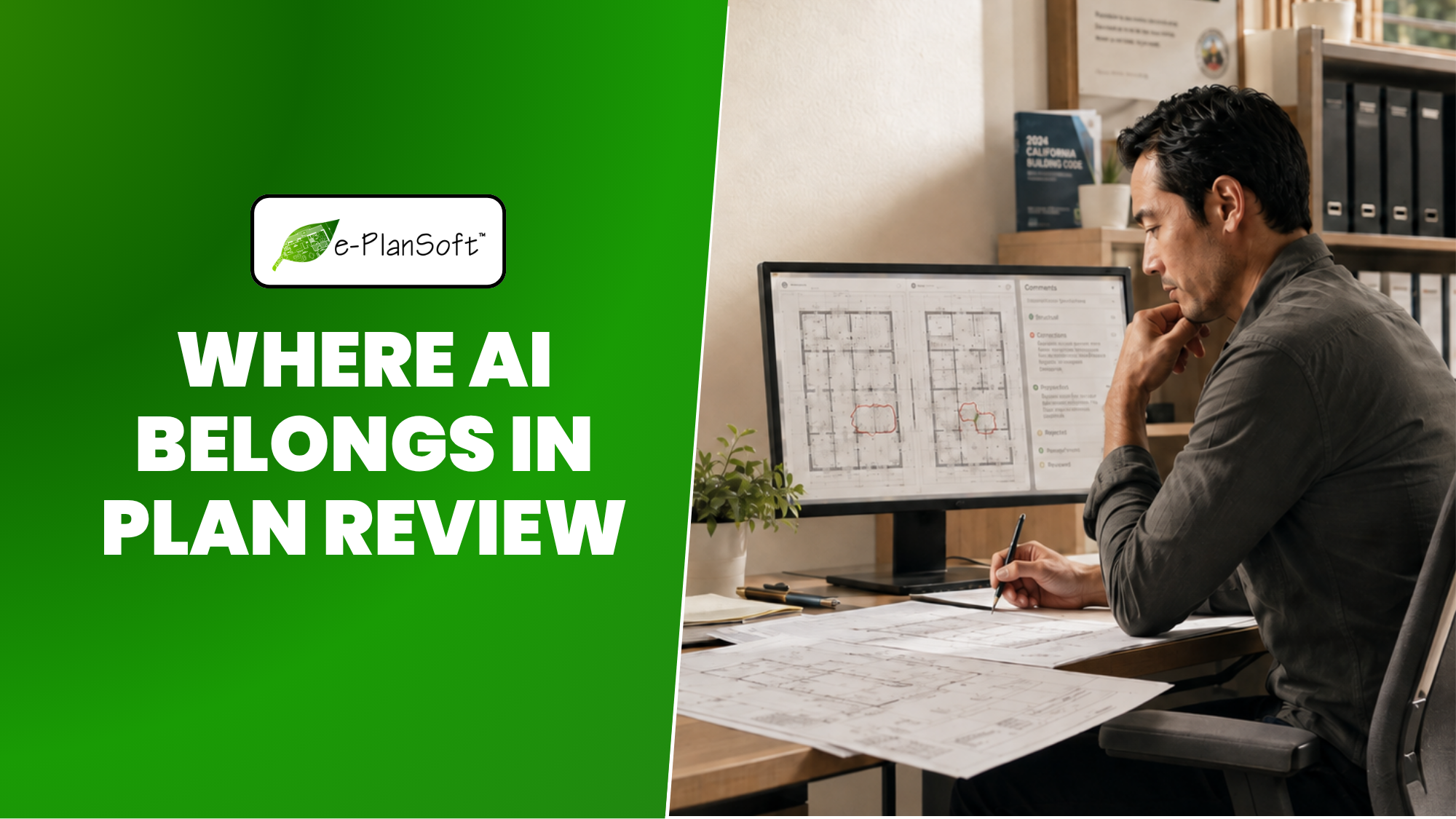
Where AI Actually Belongs in Plan Review
Everybody at NPC was talking about AI, but almost all of these tools are pointed at the same place: the front end intake and pre-submission checks.
That’s not completely misguided. Front-end AI catches incomplete submissions and can stop the clock on your SLA before the review starts, which is a genuinely useful party trick if you're getting hammered on cycle times.
But if intake is all the AI is doing, it’s only doing a quarter of the job. As we like to say, pre-submission AI isn’t enough by itself to solve the complete plan review problem.
We see four places where AI can make a big difference - genuinely shortening approval cycles while improving the working lives of the people leading the process:
- Intake and Pre-submission: Catching obvious problems before they consume reviewer time.
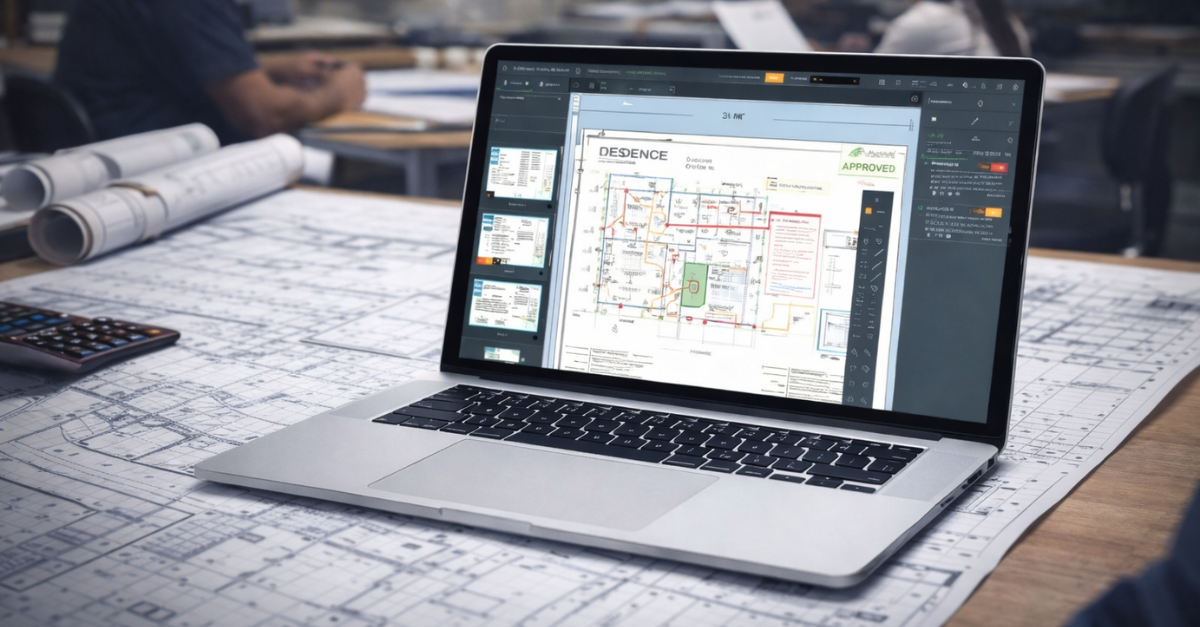
- Reviewer Assistance: Surfacing code recommendations in context and accelerating the time it takes to orient to a new plan set and start applying judgment.
- Resubmittal Processing: Automatically tracking context and “what actually changed” between submissions to eliminate flipping between plan sets.
- Comments Report Quality: Making sure feedback is clear, easy to interpret, consistently formatted, and tied to the right code citations, making any resubmission required easier for applicants (and cutting down on needless cycles in the plan review process).
When you attack all four of these areas, you compress the whole cycle. Not by replacing the reviewer, but removing the barriers standing in the reviewer's way—a concept we explore in our blog on Supercharging the Plan Reviewer in 2026.
The Signs It's Time to Get off Paper + Email
While many of the vendors (us included) were showing off their new AI functionality, many planners we met with were asking for guidance on a much more fundamental problem: How to move beyond an email-and-paper-based plan review process.
Part of the challenge for the teams we spoke with is around “when it’s time to think about something new.” While most teams still managing plan sets by hand would admit the process could be more efficient, it can be hard to make the call on when to seriously explore digitizing their plan review process.
Here’s our list of some of the signals that tell you “it’s time”:
- You’ve lost a plan set in email: If this has happened, it’s a sign that your tools are no longer capable of supporting the volume of work you’re handling.
- Complex team coordination: If you have multiple reviewers spread across different departments, you’re trying to coordinate something paper wasn’t built to handle. When reviewers don’t know what other departments have flagged, you end up with contradictory comments and manual rework.
- The growth wall: If your city is growing, you’re going to hit a wall, not because your reviewers aren't good, but because you can’t find more of them. We heard this at the conference: the workforce isn't there. You can’t staff your way out of a paper problem; you have to make the team you have more productive.
- SLA pressure: Once you have formal cycle-time requirements, whether it’s five days or two weeks, the math changes. You need to take waste out of the process everywhere you can find it. Paper doesn't help you move faster; it just adds more places for things to disappear.
Here’s Matt and Paul from our team sharing their thoughts on the clear signs it’s time to move off paper/email plan review - and how e-PlanSoft helps teams make the transition while minimizing disruption.
A Double-Edged Approach to Innovation
Whether it’s moving off paper or implementing AI, solving these problems requires more than just buying new software. It requires a strategy that understands how a reviewer actually spends their day, and doesn’t ignore the little things that can make a big difference for an individual plan reviewer.
This is the kind of thinking that feeds our “top-down / bottom-up” product strategy at e-PlanSoft.
The Bottom-Up Foundation
We start by addressing the rough edges in the everyday plan review process. We look for measurements that take too many steps, plan orientations that fight the reviewer. The impact of these small 1-2% improvements compounds quickly and, most importantly, they reduce the reviewer’s mental fatigue. Sand off enough rough edges and you give that energy back to the reviewer.
The Top-Down Layer
This is where AI comes in, but placed smartly and not sprinkled everywhere because it's 2026 and you're “supposed" to have AI. It has to show up where the reviewer actually needs the assist: working on the plan set, surfacing codes, assembling comments, and tracking changes.
When the foundation is solid and the AI is placed at the right moments, these two vectors of innovation amplify each other. The reviewer moves faster on the basic tasks and gets a powerful helping-hand on the harder ones.
That combination is what a product strategy built around the actual needs of a reviewer looks like.
Whether you’re fed up with paper or looking for AI that actually makes an impact for your reviewers, let’s talk. Request a demo today to see how our platform is reducing cycle times for reviewers and what we’re building with AI.
 e-PlanSoft™ Team
 Debra Senra